The Myth That Rural Crafts Never Change
Rural crafts change as makers adapt tools, materials and uses; learn how small choices can renew a recognisable tradition without erasing its character.
Rural crafts change whenever a maker replaces a worn tool, finds a new use for a familiar object or chooses a material that is now easier to obtain. The belief that a craft tradition never changes can make these ordinary decisions seem like departures, even when the finished work remains recognisable.
Imagine a village maker who wants to keep making woven rush baskets after the local supply becomes unreliable. This invented situation offers a way to see what adaptation can involve: not a dramatic reinvention, but a series of choices about material, tools and purpose, with each choice judged against the qualities that make the basket familiar.
A familiar basket meets a changed material supply
In this hypothetical village, the maker has learned to weave a broad, shallow basket used for carrying gathered produce. Its recognisable features are a rounded base, a firm rim and a repeating over-under pattern. Neighbours know the form and value its usefulness, but rushes collected from a nearby wet place are no longer dependable from season to season.
The maker does not begin by asking how to preserve every detail. Instead, the first question is which parts of the basket matter most to its identity and use. The woven pattern and sturdy rim may be essential, while the exact source of every strand may be less so.
This distinction matters because traditions are often described as if they were single, unchanging objects. In practice, a craft is made from linked decisions: what to make, which materials to use, how to shape them and who the work is for. A change in one part need not erase the others.
The maker compares substitute fibres before weaving
The maker considers willow withies, raffia and a commercially prepared paper cord. Each offers different qualities. Willow is familiar as a rural material but may be too rigid for the fine pattern; raffia is flexible but gives the basket a different surface; paper cord is easy to handle, though its appearance may not suit a basket expected to work outdoors.
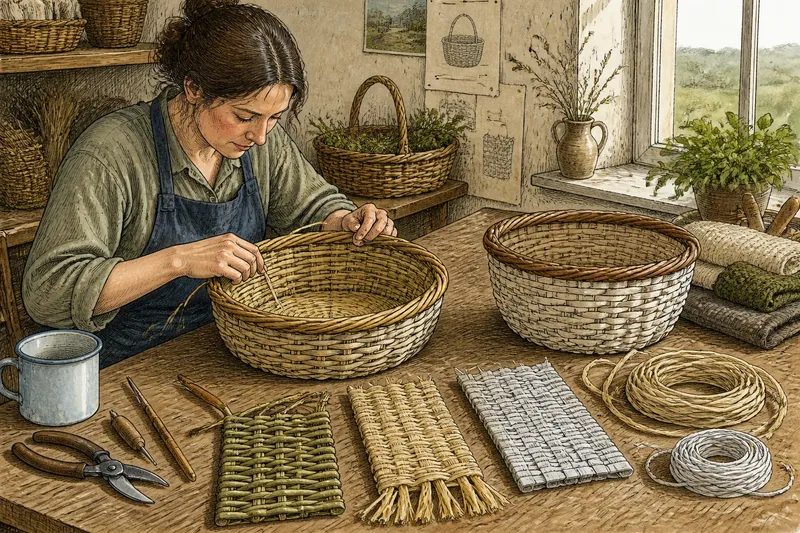
Rather than switching the whole basket at once, the maker weaves small sample strips. These are not presented as proof that one option is best; they are a practical way to observe how each fibre bends, holds a curve and sits beside the others. The maker can also compare the samples with an older basket, noticing which visual qualities are central and which can shift.
Suppose the paper cord proves suitable for a basket kept indoors, while willow remains preferable for the rim. The maker could use the two materials together, preserving the familiar silhouette and pattern while allowing the body to use a different fibre. The result would not be identical to earlier work, but its structure would still be legible as the same kind of basket.
Tools change the movement of the work
A material change often brings a tool change with it. The maker may use a blunt weaving needle to guide paper cord through tight gaps, while relying on hand pressure to shape the willow rim. A small pair of secateurs can trim the willow ends, and a wooden bodkin can open a space without splitting the weave.
These tools do not automatically make the craft less traditional. Their importance lies in what they allow the maker to do. If a new tool helps produce the same firm edge or consistent pattern, it may support continuity rather than oppose it.
The maker also pays attention to the pace and feel of the work. A fibre that kinks easily may require shorter lengths; a stiff strand may need a looser weave. Such adjustments are knowledge in action, even if they are not written in a pattern book. A tradition survives through this kind of attentive handling, not simply through repeating a set of motions without regard to the material.
A new purpose can preserve an old form
In the invented situation, the original basket was intended for gathering produce. The maker now hears from neighbours who want a version for holding knitting, folded cloth or tools by the back door. The basket’s shape still suits these uses, but the indoor version can be lighter and made with a more decorative fibre.
This is a change of purpose, not necessarily a rejection of the old one. Different uses call for different choices: a basket carried outdoors may need a denser weave and a tougher rim, while one kept in a dry room can prioritise lightness or colour. The maker can name the distinction plainly so buyers understand what each version is meant to do.
That clarity also helps prevent a common confusion: treating every variation as either a betrayal or an improvement. A new version can be good for one setting and unsuitable for another. The craft gains room to adapt when makers describe those differences rather than claiming that one form must replace all the rest.
How can a craft change and remain recognisable?
Which features make the basket recognisable?
The rounded base, repeating weave and sturdy rim give the basket its familiar character in this scenario. A maker can identify such features by comparing examples and asking which shapes or techniques people notice first.
Does a new material alter the craft’s identity?
Not by itself. A substitute fibre may change colour, texture or handling, while the form and weaving logic remain familiar; the important point is to describe the material honestly and make clear what the object is suited to.
How can a maker introduce a variation?
Make one limited change at a time, such as using paper cord for the basket’s body while keeping the willow rim. That makes it easier to see what the alteration affects and to explain the result to someone who knows the older form.
What should be kept from earlier practice?
Keep the knowledge that still serves the work: how to judge tension, form a sound edge and choose a weave for its intended use. A maker need not preserve an awkward process solely because it is old, but should understand what that process contributed before setting it aside.
The finished basket makes change visible without hiding it
By the end of the hypothetical walk-through, the maker has two related baskets: a robust version using willow where strength matters, and an indoor version combining willow with paper cord. Both retain the rounded base, repeated weave and firm rim. Their differences are visible rather than disguised, and their uses are explained in ordinary terms.
The lesson is not that every alteration belongs in every tradition. A maker can reject a material that does not suit the intended work, or keep a familiar technique where it remains useful. The point is that continuity is a considered choice, not the absence of change.
When you look at a rural craft, notice both the recognisable form and the decisions beneath it. Ask what the maker has kept, what has shifted and why. That question makes the living practice easier to see: a tradition can hold its character while responding to the materials and needs in front of its makers.