The Village Fair Before the Fairground Rides
The village fair began as a meeting place for trade and sociability; learn how its market roots shaped the kind of public gathering it became.
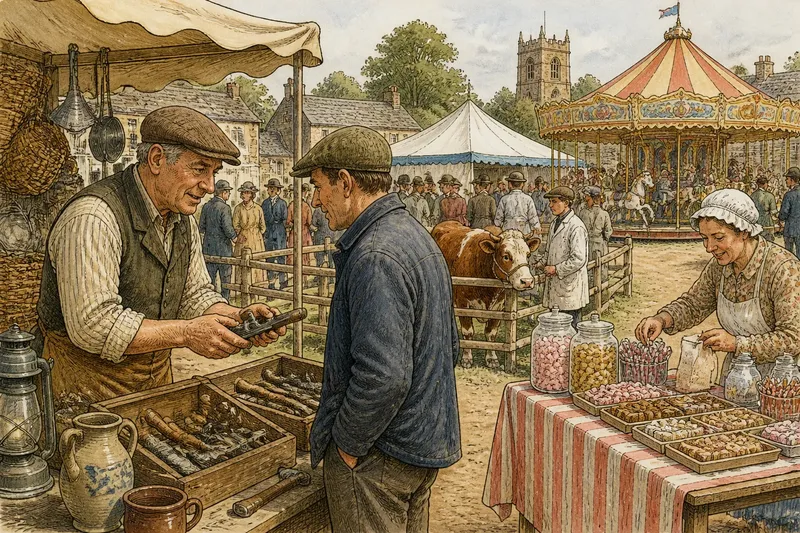
At a village fair, a table of second-hand tools may sit beside a sweet stall, a livestock ring or a noisy ride. The village fair’s older market associations help explain why these different activities can belong to the same gathering: people came not only to buy and sell, but also to meet, watch and take part in public life.
To understand a particular fair, ask what it is for now and what traces of its earlier purpose remain. The answer depends on the place: one event may still centre on trading animals or produce, while another is chiefly a day out for families. This guide sorts fairs by that balance, so you can read their character without assuming every village follows the same pattern.
Start by identifying what the fair is organised around
A fair is not simply a market with decorations, nor is it necessarily a collection of rides. It is a recurring public gathering whose attractions can include commerce, performances, contests, food, amusements and informal visiting. The name may persist even as the mix changes.
Older fairs often grew from a recognised occasion when people from surrounding settlements could assemble in one place. Trading was a practical draw: sellers brought goods, livestock or services, and visitors could compare what was available. The event also made room for entertainment and social contact, because a crowd gathered for business was already a crowd able to watch a performance or catch up with neighbours.
That combination matters more than a single origin story. A fair’s identity may rest on its date, its meeting place, an annual ceremony, a market tradition or the way local groups use it. To find the emphasis, look at the programme, the layout and who is invited to participate rather than relying on the title alone.
Choose the market-centred fair if exchange still leads
If the main draw is buying, selling or showing goods, a market-centred fair preserves the clearest link to older trading customs. You may see craft tables, produce stalls, livestock displays, equipment, household goods or a small auction. These activities make exchange visible, even when the goods and rules differ from those of an earlier market.
Look for signs that trade shapes the event rather than merely filling spare space. Stalls may be arranged to encourage browsing, sellers may demonstrate how something is made or used, and an animal or produce class may invite people to compare qualities. A livestock event has a different purpose from a general makers’ market, so the programme should make clear what is being shown and who can take part.
This type fits readers interested in the practical life of the surrounding area: what people grow, make, repair or value enough to bring before others. It can also suit a visitor who wants conversation with stallholders rather than a tightly scheduled show. Carry cash only if you prefer it, but do not assume every seller uses the same payment method; check event information if that affects your plans.
Choose the entertainment-led fair if the programme is the main draw
Some fairs now organise the day around performances, rides, games or demonstrations. In that setting, trading remains present, but it may serve as one attraction among many. The gathering’s public character comes from shared spectatorship: people watch the same contest, cheer a local performer or bring children to a familiar amusement.
Rides are especially visible, which can make them seem like the fair’s defining feature. Yet they are one way an event draws a crowd, not a complete explanation of what a fair is. A performance stage, dog show, tug-of-war, dance display or local competition can play a similar role by giving visitors a reason to gather at a particular place and time.
Choose this kind of fair if you want a day structured by scheduled activities and a lively crowd. Check whether the programme gives start times and whether tickets or separate arrangements apply to particular attractions. If you prefer a quieter visit, arriving around a display or demonstration rather than the busiest amusement period may make it easier to see what is happening.
Choose the community-centred fair if participation matters most
At a community-centred fair, local clubs, schools, charities, performers or residents may shape much of the programme. Its distinguishing feature is not the absence of commerce or entertainment, but the role people from the area play in making the event. A stall raising funds for a local group and a display prepared by a village organisation can make the fair feel rooted in its setting.
This kind of gathering suits someone who wants to understand how a place represents itself in public. Notice which groups have a visible role, what skills or interests are demonstrated, and whether visitors can join an activity rather than only watch. A noticeboard, printed programme or list of stallholders can show who has helped organise the day.
Community involvement does not mean the fair has one fixed or universally shared identity. Residents may value different parts of it, and an event can welcome visitors while still reflecting local habits. Treat the programme as a snapshot of who is participating this year, not a complete portrait of everyone in the area.
Choose by situation when the fair mixes several purposes
Many fairs combine trading, entertainment and community activity. Rather than trying to assign one label, choose according to what you want from the visit and read the event’s details with that purpose in mind.
- If you want to browse: look for a stall list or market area, and allow time to speak with sellers. This suits a visit centred on goods, demonstrations or local produce.
- If you are going with children: check which activities are suitable for them and whether quieter displays sit away from the rides or music. That helps you choose a manageable part of the event without expecting every attraction to suit every child.
- If you want to watch a specific event: find its scheduled time and location before setting out. A competition or performance may be the anchor of your visit, while the stalls and other activities fill the gaps.
- If you are interested in local organisations: look for club stands, community displays or volunteer-run activities. These offer a clearer view of who contributes to the gathering than a general attraction list.
- If you want a quieter outing: check the programme for demonstrations, craft displays or other activities that do not depend on the busiest rides. The quieter parts may be easier to enjoy outside peak arrival times.
Say you are planning a visit with a relative who wants to see local makers while a child hopes for rides. If the programme lists a craft market in the morning and amusements later, you could begin with the stalls and meet again near the rides. The observable benefit is a visit that gives each person a clear part of the day, rather than leaving both to search through a crowd for what they came to see.
Why can a fair keep its name as its purpose changes?
Did village fairs begin as trading events?
Many older fairs had strong market associations, bringing sellers and buyers together at a recurring gathering. Their exact origins and customs vary, so a fair’s local history is best understood through its own programme, records or community accounts.
Are village fairs still markets?
Some retain substantial trading, while others give more space to rides, performances or organised community activities. A stall area alone does not make commerce the main purpose; the whole programme indicates how the event is balanced.
Why are rides associated with fairs?
Rides offer a conspicuous form of amusement and can become a familiar feature of an annual gathering. They are part of the fair’s changing public character, rather than evidence that trading or meeting has disappeared everywhere.
How can I tell what a local fair is like before visiting?
Read the current programme, stall information and event notices, then note what receives the most space and attention. If details are unclear, the organisers or venue can explain whether the day centres on a market, performances, rides or community participation.
Read the fair as a public meeting place
A fair’s market roots are useful context, but they do not dictate what an event must look like today. Its public character is made through the activities people bring together: selling, showing, performing, watching and meeting. Those purposes can overlap without becoming identical.
When you visit, notice where people pause, what draws a shared audience and which parts invite conversation. A stall can prompt an exchange between seller and buyer; a contest can bring spectators together; a club display can connect visitors with local organisers. These are different kinds of contact, all possible within the same fairground.
The village fair is easiest to understand when you ask what its particular gathering makes possible. If exchange leads, explore the market; if a scheduled show matters, plan around it; if local participation is the draw, look for the groups behind the programme. That way, the fair’s older associations become a way to read its present life, not a template imposed on every event.