Open Hearth, Range or Kitchen Table: Where Does a Household Tradition Gather?
Choose a hearth, range or kitchen table for a household tradition, and shape a gathering that fits daily routines, shared tasks and the space you have.
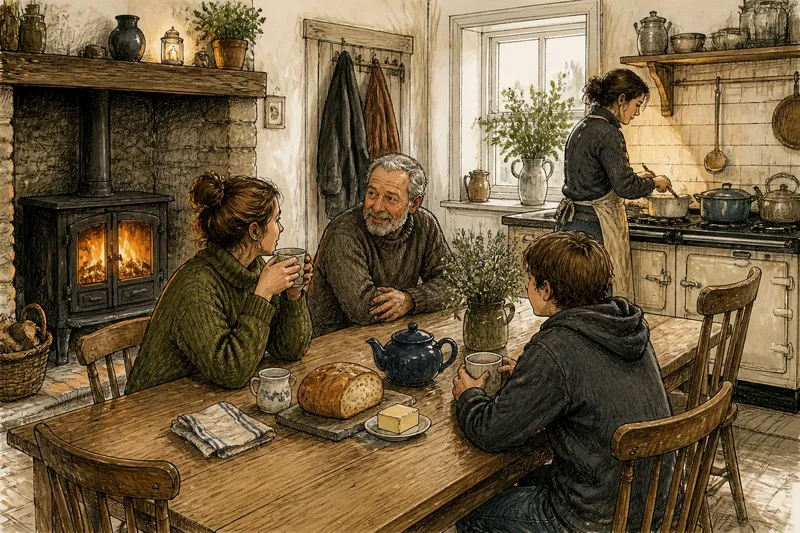
Where should a household tradition gather when one person remembers the hearth, another heads for the cooker and everyone eventually needs somewhere to sit? Choosing a centre for a household tradition is less about recreating an old room than noticing what people already do together. A hearth, range and kitchen table each invite a different kind of attention.
Start by watching an ordinary day. Notice where people pause, talk, wait for food or return after working outdoors. That small map of daily life gives you a more useful starting point than choosing a spot because it looks suitably traditional.
Choose the kind of togetherness you want
A hearth gathers people around warmth and a shared view. In a home with a fireplace or wood-burning stove, people may settle nearby to talk, mend something or sit quietly after the day’s work. Its customs tend to be informal: the gathering can begin without a meal or a set time.
A range or cooker centres attention on preparation. Someone stirs a pot while another lays out bread or clears a worktop; conversation grows around a task with a visible result. This can suit a household tradition built around making something together, such as soup on a particular evening or baking for a regular visitor.
The kitchen table favours conversation that can continue after the task is finished. It makes room for eating, sorting letters, shelling peas or sharing a cup of tea. If the tradition is chiefly about hearing one another, rather than tending a fire or preparing a dish, the table may be the natural centre.
Check how the room is actually used
Look at the route people take through the room, where coats and bags land, and whether anyone needs the space for ordinary chores. A tradition is easier to keep when it fits the household’s habits instead of asking everyone to rearrange the evening around it.
Consider comfort as well as atmosphere. A hearth may be inviting but awkward for someone who cannot sit low or get close to the fire. A cooker can draw people into a narrow working area, while a table can feel too formal if the household rarely eats together there.
Keep safety and access in view. Never make a fire the centre of a gathering unless the appliance is properly used and maintained, and leave cooking to the person responsible for it. For appliance use, follow its maker’s instructions and any local rules.
Give the tradition a simple shape
Decide what happens at the gathering, who can join, and what signals its beginning. A custom need not be elaborate: lighting the hearth after supper, preparing a familiar dish together, or setting aside the first cup of tea for a visitor can all provide a recognisable moment.
Make the invitation clear without turning it into a duty. A recurring cue—a kettle going on, a pan being set out, or a chair pulled near the fire—helps people know that the gathering is beginning. Leave room for someone to arrive late or simply listen; shared customs work better when participation has more than one form.
Say you want to establish a Sunday kitchen-table tradition, but family members arrive home at different times. Imagine that, on the first Sunday, you set out a loaf, butter and a pot of tea and invite whoever is home to sit for a short catch-up. You then leave the tea things available for later arrivals, so they can join without interrupting anyone. The expected observable result is that people can exchange news when their routines allow, rather than needing a formal announcement or a shared arrival time.
Try the custom before making it a fixture
Begin with a single occasion, using the place that already supports the activity. Keep the preparation modest and notice what people do: do they linger, talk easily, help with the task or drift away once it is complete? Their behaviour offers practical clues about whether the centre suits the purpose.
If the gathering feels strained, change one element rather than discarding the idea. Move from the cooker to the table once the food is ready, or make the hearth a place to sit after the meal rather than during it. A household can use more than one centre, provided each has a clear role.
Pay attention to the work the custom creates. A tradition that leaves one person cooking, serving and clearing while everyone else gathers may be hard to sustain. Sharing a small task—setting cups out or bringing a plate to the table—can make the gathering feel like a household practice rather than a performance by its host.
Questions to settle before choosing a centre?
Is a hearth necessary for a household tradition?
No. A hearth offers warmth and a shared focal point, but the custom can gather around a table or another comfortable place. The useful test is whether the chosen spot supports the kind of time people want to share.
Can the cooker and table serve the same tradition?
Yes, especially when preparation is part of the occasion and eating or talking comes afterwards. Give each place a distinct part: the cooker for making, the table for sitting down together.
What can a household use without a fireplace or range?
Use the place people already associate with pausing together, such as a kitchen table or a bench by the back door. A familiar action, like sharing tea after outdoor work, can give that spot its meaning.
How can a tradition include people with different routines?
Choose a flexible cue and avoid making everyone’s presence a condition of success. A gathering that welcomes whoever is home, with a simple way to join later, can fit changing household days.
Let the place earn its meaning
After a few occasions, ask what people remember and what felt natural. The answer may be the smell of bread near the range, a conversation around the table, or the quiet pause beside the hearth. That detail can become the tradition’s anchor, even if the household later moves the gathering.
For a household tradition, the best centre is the place that makes its purpose easy to recognise and its welcome easy to accept. Let the hearth, range or kitchen table support the custom rather than dictate it; the smallest useful sign may be a chair left clear for whoever comes in next.