Why Harvest Suppers Became a Way to Mark the Year
Why harvest suppers mark the year: see how shared food turns seasonal work into gratitude, memory and a local ritual that can adapt to each village.
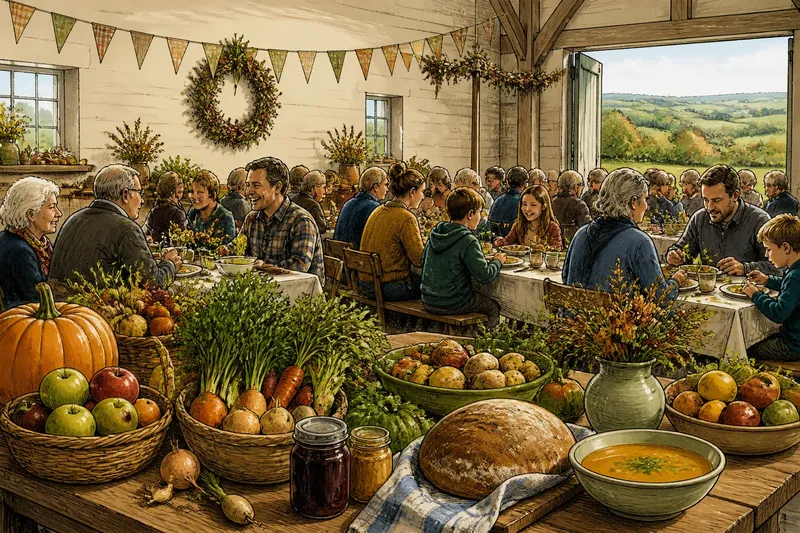
Why harvest suppers mark the year becomes clear when a village table fills after the work of gathering crops. The meal does more than celebrate food: it gives neighbours a shared moment to recognise labour, changing weather and the turn from growing season towards winter.
These suppers are not one fixed custom. A parish hall meal, a farm gathering or a modest bring-and-share can all carry the same seasonal meaning, while their menus, songs and manners reflect local habits. The most revealing details are often practical: who brings the vegetables, which room is used, and what people choose to remember aloud.
The meal makes seasonal work visible
Harvest work can be spread across fields, gardens, sheds and kitchens. A supper brings those different tasks into one room. The person who cut grain, the neighbour who lent a trailer and the cook who bottled fruit may each have contributed to the food or to the season’s work, even if their labour happened out of view.
This shared account matters because a harvest is never simply a pile of produce. It depends on soil, rain, equipment, timing and cooperation. At the table, people can acknowledge those dependencies without turning the evening into a formal report: a remark about muddy boots or a familiar dish may be enough to prompt a fuller story.
Local customs can also make the work legible to younger people. A loaf baked with local flour, a bowl of orchard apples or a jar of beans from someone’s allotment gives children something tangible to ask about. The meal can then pass on knowledge of what grows nearby and when it is ready, without requiring a lesson or speech.
Gratitude belongs to people and place
Harvest gratitude may be religious, civic, family-based or simply expressed through hospitality. Some gatherings include a blessing or a collection for a local cause; others begin with thanks to cooks and growers. These forms differ, but each turns private appreciation into something a group can hear and answer.
The custom also gives people a way to admit uncertainty. A poor crop, a late frost or a difficult season may sit alongside the pleasure of sharing what did grow. A thoughtful gathering need not pretend that the year was easy; gratitude can recognise effort and mutual help without claiming that every outcome was favourable.
That balance helps explain why harvest suppers can feel meaningful even when the meal is simple. Their purpose is not to display abundance but to notice what has been gathered and who helped make it possible. A modest pot of soup made with seasonal vegetables may express that idea more clearly than an elaborate menu.
Local details give the custom its character
There is no single harvest supper template. In one place, the event may be organised by a church or village association; elsewhere, neighbours may take turns hosting in a barn, community room or school hall. The choice of venue affects the evening’s tone: a familiar hall encourages a broad invitation, while a household gathering may keep the conversation close and informal.
Food follows local growing patterns and household skills. A district known for apples might serve a baked pudding; a coastal village could include fish alongside garden produce; a livestock area may centre the meal on a shared roast. These are possibilities, not rules, and migration, changing diets and new growing practices continually reshape what counts as local food.
Small rituals make those differences visible. Someone might arrange produce on a windowsill, bring a basket from a nearby allotment, or invite a local grower to explain what the season demanded. Another community may prefer songs, a raffle or a quiet meal with no programme. The custom works best when its details belong to the people who attend.
Planning around the harvest keeps the evening grounded
A useful starting point is to choose a date that fits the local growing season rather than an abstract calendar ideal. The harvest may arrive at different times for apples, potatoes, grain or garden vegetables, and a village with mixed work may have no single perfect evening. Organisers can ask growers and allotment holders what is ready, then choose a date that allows them to take part.
Keep the menu workable for the people preparing it. A shared table can combine a few substantial dishes with contributions that travel well, such as bread, chutney or fruit. It helps to name what is needed in advance and to make room for dietary requirements, so the invitation feels open rather than dependent on everyone bringing the same kind of food.
- Ask local growers what has actually come in, then build the menu around available produce.
- Choose a venue with enough table space and a kitchen or serving area suited to the food.
- Invite contributions by type, such as a savoury dish, bread or pudding, to avoid an unbalanced spread.
- Offer a non-food way to help, such as setting tables, welcoming guests or clearing away.
- Decide whether a blessing, short welcome or informal toast suits the group, and make participation optional.
- Set aside a place for labels where ingredients may matter to guests.
Say a village association finds that its usual early-autumn date falls before the local apples are ready. It shifts the meal later, asks an orchard neighbour to bring a basket of fruit, and invites a school cook to prepare a pudding. The expected observable result is a menu and conversation tied to the actual season, rather than a generic celebration scheduled by habit.
What do people ask about harvest suppers?
What is the purpose of a harvest supper?
It brings people together to recognise the season’s food, labour and mutual support. The meal can express gratitude while preserving local memories and customs.
Does a harvest supper need to be religious?
No. Some gatherings include a religious blessing, while others are organised as community or household meals. Hosts can explain the format in the invitation and make any spoken ritual voluntary.
What food should be served at a harvest supper?
Choose dishes that reflect what is available locally and can be prepared by the people involved. Seasonal vegetables, bread, preserves and fruit are familiar options, but there is no required menu.
When should a village hold its harvest supper?
Choose a date that follows the area’s main harvest activity and suits the people who grow, gather and cook the food. Local crops and weather vary, so a flexible date can be more fitting than a fixed tradition.
A supper can keep changing and still mark the year
Custom does not depend on preserving one menu or ceremony unchanged. A village can adjust its venue, welcome new residents, include produce from allotments or simplify the programme as people’s circumstances shift. What gives the supper continuity is the recurring act of gathering after a season of work.
That is why harvest suppers mark the year without needing to look identical from one place to another. When people share food, name the work behind it and make room for the season’s particular stories, the meal becomes a record of local life as well as an occasion. Its most useful tradition may be the invitation itself: come, bring what you can, and notice what this year has given and asked of the community.